I am a colonized woman. My references were populated by european civilizational thought, and that was before I even arrived here. The thinking of white european men, this way of seeing and experiencing the world (and art) has organized my gaze and domesticated my body and my gestures since forever. It was as expected.
From this place of being colonized, with the very instruments of this colonization, with the weapons of western culture and civilization, can I decolonize myself? Can I decolonize from here in the eurocentric center, from inside the viscera of the monster knowing that if I kill all the colonizing microorganisms, I create the risk of an aseptic and pure situation that is even more dangerous? The solution is miscegenation.
How can I retrace the path towards my origins from the depths of this colonized body and mind? How can we excavate this path, extract it, pull it out without it dying, separated from everything that surrounds it? So I try to visit these white european colonizing civilizational bases of mine: art, drawing, canons, mythology, greek tragedy, psychoanalysis. In each of them, a tear, a breach for the emergence, for the mixing, an un-purification from within. Miscegenation is the possibility of joy.
Search in greek mythology and tragedy for the Moirai, the Erinyes, the Harpies, the Gorgons. Search in psychoanalysis for remains, remnants, traces. Search the art history for the details, the pieces, the fragments. Search for the banalities, the trifles, the insignificances in everyday life.
The easy, imperative and strident places of consumer society or the discreet and evanescent places of origins and memory? A work that oscillates between cash tickets, labels, the impersonal messages of fortune cookies, astrological predictions and the search for roots in the remains of grandmothers, mythological ancestors, erinyes and moirai. The path of doing, of the hand, of slow time, of repetitive gesture work on paper, the path of drawing and automatisms, impersonal writing, thermal printing, without any trace of human action. How can one find oneself in this dichotomy if not through the construction of a poetics of verse?
Obverse and reverse.
Front and back.
Front and verse.
Verse.
Even in the most mechanical, I insert something, a subversion of utility, a transgression of words. Attempt to re-humanize, remove from use, from consumption, in the hope that something else will emerge, in the hope that at some point I will reconnect with that other gesture, with the textures, with the action of nature. Attempt to force the most dehumanized to the point of origin, point of origin’s creation, point of the narrative. One-point invention.
There is a technique called “caviardage”, which consists of covering words and images. Cover to reveal, veil to reveal, add layers to discover, add to excavate, fill to empty: contouring of the void, fictionalization of life. The origins do not reappear, what appears is the work.
Invention.
Miscegenation.
Assembly.
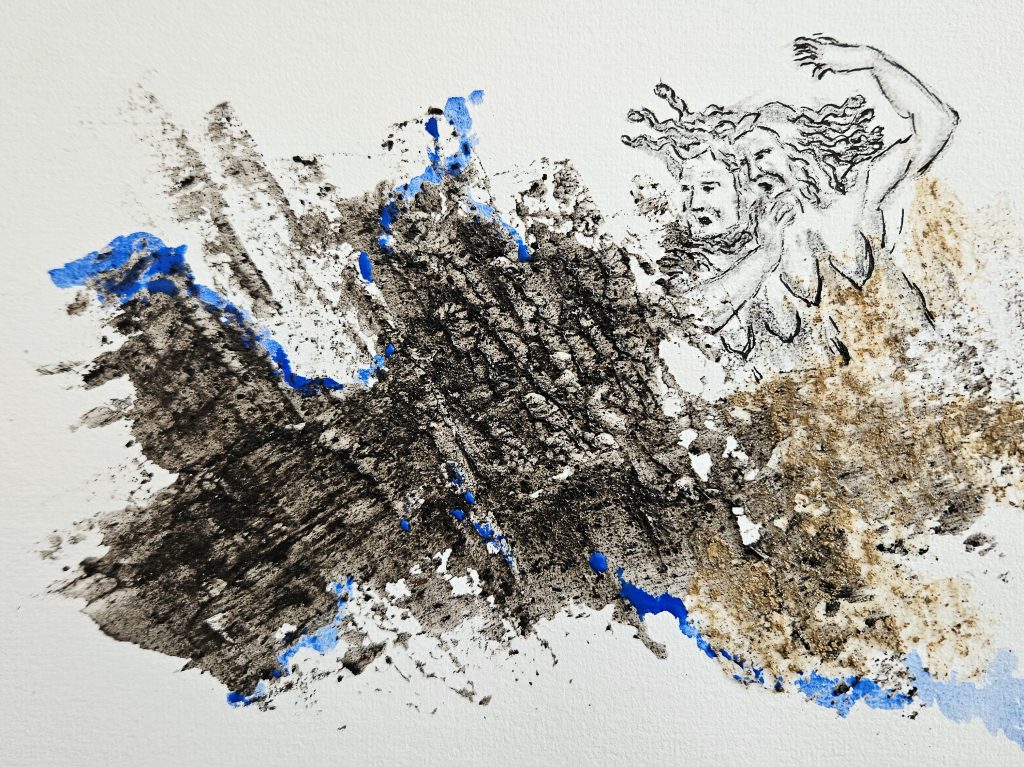
erinyes – earth (diptych):
-wet earth and burnt earth, watercolor, dry pastel and charcoal on watercolor paper 300g/m2 21×29, 2024-25.
-100g/m2 paper with typed poem in French, 21×29.7cm, 2024
You can find more of my experiments on escrit’imagem over here (written in portuguese and french only).


 alessandra m ribeiro